

Can sound frequencies really influence how relaxed we feel? It’s a question that often comes up when exploring meditation music, sleep soundtracks and auditory stimulation techniques.
Among the most widely discussed methods, binaural beats and isochronic tones have attracted particular attention. They are frequently presented as tools that may support relaxation, improve concentration or make it easier to fall asleep.
Yet behind these two terms are very different audio techniques. One relies on a perceptual phenomenon created by the auditory system, while the other uses rhythmic pulses that are physically present in the sound signal.
And despite what we sometimes read, choosing a precise frequency isn’t enough to create a genuinely relaxing experience.
To understand why, we first need to look at what happens in the brain when we listen to repetitive sounds.
Brainwaves: A Few Things Worth Understanding
Our brains never truly switch off, even during deep sleep. Billions of neurons constantly exchange information through electrochemical signals.
This activity produces electrical oscillations that can be measured using an electroencephalogram, commonly known as an EEG.
Scientists identify several categories of brainwaves according to their frequency, measured in hertz (Hz).
| Brainwave Type | Approximate Frequency | Commonly Associated States |
|---|---|---|
| Delta | 0.5–4 Hz | Deep sleep |
| Theta | 4–8 Hz | Drowsiness, certain meditation practices |
| Alpha | 8–13 Hz | Relaxed wakefulness, relaxation |
| Beta | 13–30 Hz | Alertness, attention, mental activity |
| Gamma | Above 30 Hz | Information processing, cognitive functions |
These categories help us understand certain aspects of brain activity, but they shouldn’t be viewed as separate states that we simply move through one after another.
Several brainwave rhythms coexist at any given moment. Their relative strength varies depending on the brain region, the activity being performed and many other factors.
This distinction becomes particularly important when discussing music that incorporates specific frequencies.
Can the Brain Synchronise With a Sound Rhythm?
Most of us have experienced how music can influence our behaviour. An energetic rhythm might make us want to move, while a slow, steady composition can encourage us to settle down and release tension.
Our auditory system is especially sensitive to rhythm.
When exposed to repetitive stimulation, it can produce neural responses that follow the timing of those sounds under certain conditions.
This phenomenon is studied in the field of brainwave entrainment.
The underlying idea is that an external rhythm may influence certain oscillations in brain activity.
However, observing an auditory response to a 10 Hz pulse does not mean that the entire brain automatically begins oscillating at 10 Hz.
Nor does it mean that the listener instantly enters a state of deep meditation.
This is where some of the explanations circulating online deserve a little more nuance.
Binaural Beats: When the Brain Creates a Rhythm of Its Own
The principle behind binaural beats is surprisingly interesting.
Imagine playing a frequency of 200 Hz in the left ear and 210 Hz in the right ear.
Each ear receives a slightly different sound.
The auditory system processes both signals simultaneously and may create the perception of an additional rhythmic fluctuation corresponding to the difference between the two frequencies.
In this example, that difference is 10 Hz.
What makes this phenomenon unusual is that the 10 Hz beat is not physically present in either audio signal on its own.
It arises from the way the auditory system processes the two frequencies.
This perceptual effect is known as a binaural beat.
Why Do Binaural Beats Require Headphones?
The answer lies in the way the technique works.
For the intended binaural effect to occur, each ear needs to receive its own separate frequency.
With stereo headphones, this is relatively straightforward: the left channel carries one signal, while the right channel carries another.
When the same signals are played through conventional speakers, however, they mix together in the air before reaching the listener’s ears.
That mixture may produce an audible acoustic beat, but it no longer preserves the intended binaural phenomenon.
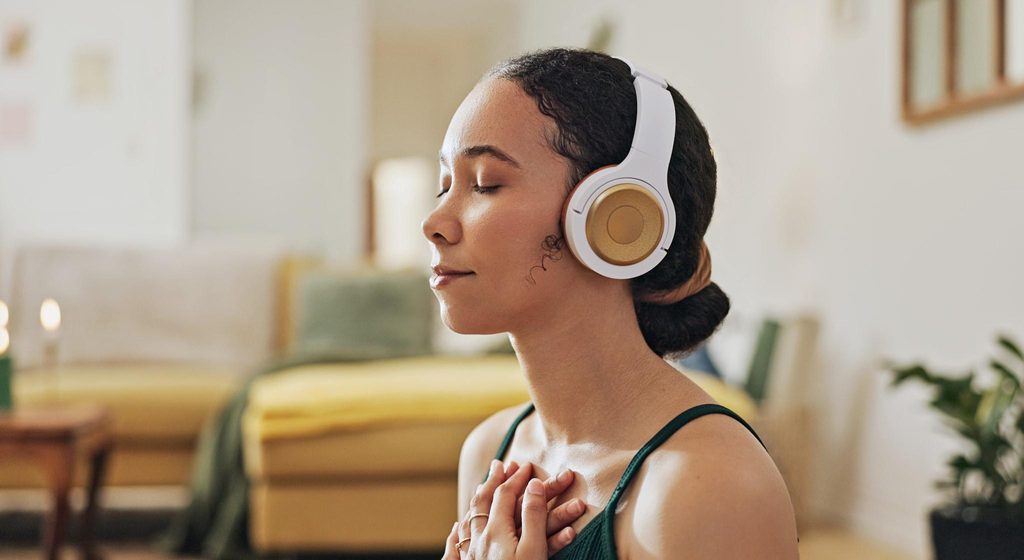
This is why music containing genuine binaural beats should normally be experienced through stereo headphones or earphones.
Another detail matters too: audio processing that blends the left and right channels, including certain spatial audio settings, can interfere with the effect.
Can Binaural Beats Be Incorporated Into Relaxation Music?
Absolutely. From a musical perspective, this is one of their most interesting applications.
Binaural beats can be combined with ambient textures, acoustic instruments and natural soundscapes.
But simply adding two frequencies to a composition doesn’t necessarily produce a satisfying result.
Their volume, interaction with the instruments and overall listening comfort all need careful consideration.
A beat that is too prominent may continually attract the listener’s attention, which is often the opposite of what relaxation music is intended to achieve.
The challenge is to integrate the technique without allowing it to dominate the musical experience.
This is one of the approaches we explore at 3 Oaks Music, combining instrumental composition, atmospheric sound design and frequency-based audio techniques.
Isochronic Tones: A Different Approach to Rhythmic Sound
Isochronic tones work quite differently from binaural beats.
In this case, there is no need for the auditory system to compare separate frequencies delivered to each ear.
Instead, the technique relies on a sound whose intensity changes at regular intervals.
Imagine a continuous tone that is briefly interrupted several times per second. The result is a series of evenly spaced pulses.
If this modulation repeats ten times per second, we describe it as a 10 Hz pulse rate.
Unlike a binaural beat, this rhythm is physically present in the audio signal.
It doesn’t depend on the perception of two different frequencies presented separately to the ears.
Can You Listen to Isochronic Tones Without Headphones?
Yes, and this is one of their main technical advantages.
Isochronic tones can be played through conventional speakers, headphones or other audio playback systems.
This makes them potentially useful in environments where listening through headphones isn’t practical.
Meditation rooms, relaxation spaces and certain immersive audio installations are obvious examples.
There is, however, a challenge.
Isochronic pulses can become tiring when they are too pronounced.
A sound that feels pleasant for a few seconds may become intrusive during a 45-minute relaxation session.
From a composer’s perspective, the task is to find the right balance between the rhythmic stimulation and the softness of the musical atmosphere.
Binaural Beats vs Isochronic Tones: What Are the Main Differences?
Although binaural beats and isochronic tones are often used for similar purposes, they rely on different auditory mechanisms and offer distinct listening experiences.
| Feature | Binaural Beats | Isochronic Tones |
|---|---|---|
| How they work | Two slightly different frequencies, one delivered to each ear | Regular modulation of an audio signal |
| How the rhythm is produced | Perceived through auditory processing | Physically present in the sound |
| Headphones required | Yes, to preserve the binaural effect | No |
| Speaker playback | Does not properly reproduce the intended binaural effect | Possible |
| Listening experience | Often subtle and less pronounced | Usually more clearly rhythmic |
| Musical integration | Suitable for certain stereo compositions | May require careful softening of the pulses |
Are Isochronic Tones More Effective Than Binaural Beats?
It’s sometimes claimed that isochronic tones are more powerful because their pulses are more clearly defined.
But this conclusion is too simplistic.
A stronger acoustic modulation may produce a different measurable response in the auditory system. That doesn’t necessarily mean it produces greater relaxation, better concentration or improved sleep.
Auditory responses and psychological benefits are not the same thing.
Some listeners prefer the subtle quality of binaural beats. Others enjoy the more noticeable rhythm of isochronic tones.
And some people may find ordinary relaxation music, without either technique, more comfortable.
At present, there is insufficient scientific evidence to conclude that one approach is universally more effective than the other.
Binaural Beats for Sleep: Can Delta Frequencies Help You Fall Asleep?
When searching for music designed to support sleep, you’ll quickly come across references to delta and theta brainwaves.
There’s a reason for this.
Delta activity is strongly associated with deep sleep, while theta oscillations occur in several situations, including drowsiness.
The idea of using binaural beats with difference frequencies corresponding to these ranges can therefore seem appealing.
But an important question remains: does listening to a 3 Hz binaural beat actually increase delta activity and improve sleep?
Research has produced mixed results.
Some studies suggest potentially beneficial effects on relaxation or certain sleep-related measures. Others have found no significant improvement.
It’s also difficult to separate the effects of binaural beats from those of the music itself.
A slow composition, with gentle harmonies and no sudden changes in volume, may already help create an atmosphere suitable for rest.
The habit of setting aside time to unwind each evening may also contribute to the experience.
Sleep Music Is About More Than a Single Frequency
When composing music intended for sleep, several elements deserve just as much attention as the frequencies being used.
First, there’s the choice of instruments. Sounds with a strong high-frequency presence may be pleasant in small doses but become more noticeable when we’re trying to fall asleep.
Dynamics also matter. An unexpected musical crescendo can disturb a peaceful atmosphere, even if it works beautifully from a purely artistic perspective.
Then there’s duration.
Composing five minutes of relaxing music and creating a soundtrack designed to accompany several hours of rest are two very different challenges.
A long-form musical experience needs to evolve without constantly demanding the listener’s attention.
To explore different musical approaches to rest and relaxation, browse our relaxation music catalogue.
Binaural Beats and Meditation: What Is Their Purpose?
Meditation doesn’t necessarily mean emptying the mind of all thoughts.
Depending on the practice, it may involve observing the breath, focusing on bodily sensations, following a visualisation or simply paying attention to the present moment.
Music can support these practices by providing a stable listening environment.
Binaural beats are sometimes incorporated into meditation soundtracks, particularly with beat frequencies corresponding to the alpha and theta ranges.
However, claiming that a particular frequency automatically produces a meditative state would be an exaggeration.
Meditation takes many forms, and its relationship with brain activity is equally complex.
From a musical perspective, one principle stands out: the soundscape shouldn’t constantly draw attention back to itself.
An arrangement that is too busy, endless harmonic changes or unpredictable sound effects can become distractions.
By contrast, a composition that gives sounds room to breathe may support the natural flow of a meditation session.
Silence, resonance and gentle transitions can be just as important as the notes themselves.
Can Binaural Beats Be Combined With 432 Hz and 528 Hz Frequencies?
This is an interesting question because two very different concepts are often confused.
The first is the frequency of a sound, which determines its pitch.
The second is the frequency of a pulse or beat.
Let’s take 432 Hz as an example.
If we play 432 Hz in the left ear and 436 Hz in the right ear, the difference is 4 Hz.
Under suitable listening conditions, this may produce the perception of a 4 Hz binaural beat.
The same principle can be applied using other carrier frequencies, provided the conditions necessary for binaural perception are respected.
However, these concepts should not be mixed up.
Music tuned with A at 432 Hz does not automatically produce a 432 Hz binaural beat.
Likewise, a composition containing a 528 Hz tone is not necessarily binaural music.
Do 432 Hz and 528 Hz Have Special Effects?
These frequencies have become popular in meditation, relaxation and various energy-based wellness practices.
They may be chosen for artistic reasons or as part of a personal approach to well-being.
However, current scientific evidence does not establish that either 432 Hz or 528 Hz, on its own, possesses specific therapeutic properties.
At 3 Oaks Music, we prefer to approach these frequencies as elements of a musical soundscape rather than guarantees of a particular result.
A beautiful composition doesn’t automatically become relaxing simply because it uses a specific frequency.
Musical sensitivity, instrumental timbre, harmony and the quality of the mix remain essential.
Why Mixing Matters in Binaural and Isochronic Music
Discussions about binaural music often focus on numbers: 4 Hz, 7 Hz, 10 Hz or even 432 Hz.
Yet the technical aspect is only part of the creative process.
As soon as these methods are incorporated into an actual composition, several questions arise.
How can the pulses remain perceptible without becoming intrusive? How do we preserve the stereo separation required for binaural beats? How can we prevent certain frequencies from interacting unpleasantly with the instruments?
Isochronic tones present a different challenge.
Their repetitive character can quickly become mechanical. The shape, intensity and placement of each pulse need to be carefully controlled.
These considerations are particularly important in music designed for extended listening.
Technology Should Serve the Music
At 3 Oaks Music, we approach auditory stimulation techniques as creative tools.
The choice of a frequency or modulation should make sense within the experience we’re trying to create.
A soundtrack for guided meditation isn’t composed in the same way as music for a massage, a deep relaxation session or an immersive sensory experience.
In some projects, binaural beats may be a natural fit.
In others, a gentle instrumental composition, subtle ambient textures or nature sounds may be more appropriate.
Adding a specialised audio technique isn’t always necessary to create a calming atmosphere.
Sometimes, musical simplicity is the most effective artistic choice.
Binaural Beats, Isochronic Tones and Relaxation Music in Spas
In a spa or wellness environment, music is part of an experience that goes far beyond listening.
Guests discover a place, an atmosphere, different textures, fragrances and sometimes a carefully designed treatment ritual.
The sound environment contributes to this overall experience.
But the requirements are not the same as listening to music at home.
A soundtrack played in a massage room should remain comfortable throughout the space, without requiring excessive volume.
The equipment also matters: wall-mounted speakers, integrated sound systems, headphones or immersive audio devices.
Which Technique Is Best for a Wellness Establishment?
Binaural beats can be particularly interesting for certain individual experiences involving headphones.
This may be relevant when designing a personalised sound experience with precise separation between the left and right ears.
Isochronic tones, on the other hand, can be played through speakers because the rhythmic modulation is already part of the signal.
That doesn’t mean they should automatically be used in shared relaxation areas.
Strong, repetitive pulses may be unsuitable for an environment where several guests simply want to rest peacefully.
The choice should therefore depend on the setting, the experience being offered and the comfort of the people using it.
Creating a Sonic Identity Rather Than Just Background Music
Music can also give a wellness establishment a distinctive character.
A soundscape inspired by Mediterranean landscapes tells a different story from one evoking Asia, a forest or wide-open natural spaces.
The choice of instruments, textures and natural sounds helps build a recognisable atmosphere.
Binaural and isochronic techniques can enrich certain compositions, but they don’t replace artistic direction.
With this approach in mind, 3 Oaks Music creates bespoke music and immersive sound experiences for spas, hotels, beauty salons and wellness professionals.
Each project is developed around its intended use, the establishment’s identity and the atmosphere it wishes to offer its guests.
Discover our approach to bespoke music for spas, hotels and wellness professionals.
What Does Science Actually Say About Binaural Beats and Isochronic Tones?
Researchers have been exploring the relationship between auditory stimulation and brain activity for decades.
Several studies have investigated the potential effects of binaural beats on attention, anxiety, memory and sleep.
However, their findings have not always been consistent.
A systematic review published in PLOS ONE in 2023 examined whether binaural beat stimulation could influence brain oscillatory activity.
The researchers found mixed results and highlighted several methodological limitations in the available studies.
In other words, the phenomenon deserves further investigation, but the current evidence doesn’t support every benefit commonly attributed to it.
The distinction between a measurable neurological response and a meaningful benefit for the listener is especially important.
As for isochronic tones, clinical research specifically investigating their effects on well-being remains more limited.
It would therefore be premature to present them as a scientifically proven way to treat insomnia, improve memory or produce lasting reductions in anxiety.
None of this diminishes their creative potential.
Music can be experienced as relaxing even when the precise mechanisms behind that experience aren’t fully understood.
Personal experience has an important place in music, but it should be distinguished from medically established benefits.
How to Listen to Binaural Beats and Isochronic Tones
You don’t need sophisticated equipment to explore these techniques.
A good pair of stereo headphones is sufficient for listening to a binaural composition under appropriate conditions.
For isochronic tones, conventional speakers may also be suitable.
Comfort matters more than complexity.
It’s generally sensible to keep the volume moderate, choose a quiet environment and begin with relatively short listening sessions.
Around 20 minutes can be a reasonable starting point for exploring the sounds, although this is not a scientifically established ideal duration.
If the pulses become unpleasant or cause headaches or discomfort, it’s best to stop listening.
These experiences should also be avoided while driving or performing tasks that require full attention.
Finally, binaural beats and isochronic tones should not be considered substitutes for medical treatment.
Frequently Asked Questions About Binaural Beats and Isochronic Tones
What Is the Difference Between Binaural Beats and Isochronic Tones?
Binaural beats occur when two slightly different frequencies are presented separately to each ear. The auditory system may perceive a beat corresponding to the difference between them. Isochronic tones use regular pulses that are physically present in the audio signal.
Do You Need Headphones for Binaural Beats?
Yes, to reproduce the intended binaural phenomenon correctly. Each ear needs to receive a separate frequency. Conventional speakers allow the signals to mix together in the air.
Can Isochronic Tones Be Played Through Speakers?
Yes. Because their rhythmic pulses are already part of the audio signal, isochronic tones can be played through speakers or headphones.
Which Binaural Beat Frequency Is Best for Sleep?
Beat frequencies in the theta and delta ranges are commonly used in music designed for sleep. However, their effectiveness for falling asleep is not guaranteed, and research findings remain mixed.
Can Binaural Beats Improve Concentration?
Some studies have reported positive effects on attention or certain cognitive tasks, while others have found no significant benefits. There is currently no universal frequency proven to improve concentration reliably.
Can Binaural Beats Be Combined With 432 Hz Music?
Yes. Carrier frequencies and binaural beats can be combined within a musical composition. However, the pitch frequency of a sound and the frequency of the perceived beat are two different things.
Are Binaural Beats Safe?
Listening at moderate volume is generally considered low risk for most adults. However, long-term research remains limited. Anyone experiencing discomfort should stop listening. People with neurological conditions or particular sensitivity to repetitive sensory stimulation should consult a qualified healthcare professional before using these techniques.
Is Binaural 3D Audio the Same as Binaural Beats?
No. Binaural 3D audio aims to recreate the spatial perception of sound, including the impression that sounds are coming from different directions around the listener’s head.
Binaural beats, by contrast, rely on a small frequency difference between the ears.
These are two distinct audio techniques, although they can be combined.
Conclusion: Beyond Frequencies, It’s About the Musical Experience
Binaural beats and isochronic tones offer two interesting approaches to auditory stimulation.
Their mechanisms differ, their technical requirements differ, and their potential effects remain subjects of scientific research.
But when it comes to relaxation music, it would be a shame to reduce the entire experience to a single frequency.
A subtle melody, a carefully chosen harmony, a resonance that slowly fades away or a moment of silence at just the right time can profoundly influence how we experience a composition.
Technology opens up additional creative possibilities. It doesn’t replace listening or artistic sensitivity.
At 3 Oaks Music, we believe in bringing together musical composition, sound exploration and a thoughtful approach to the listening experience.
Whether the music is intended for meditation, sleep, wellness treatments or moments of relaxation, our aim remains the same: to create soundscapes that feel natural within each experience.
To explore our musical world, visit the 3 Oaks Music relaxation music catalogue.
Scientific References
Ingendoh, R. M., Posny, E. S., & Heine, A. (2023). Binaural beats to entrain the brain? A systematic review of the effects of binaural beat stimulation on brain oscillatory activity, and the implications for psychological research. PLOS ONE.
https://doi.org/10.1371/journal.pone.0286023
Oster, G. (1973). Auditory Beats in the Brain. Scientific American, 229(4), 94–102.
https://doi.org/10.1038/scientificamerican1073-94
This article is provided for informational purposes. The audio techniques discussed are intended for musical and wellness applications and should not be considered medical treatments.